Ultimate Semantic SEO Tools Guide
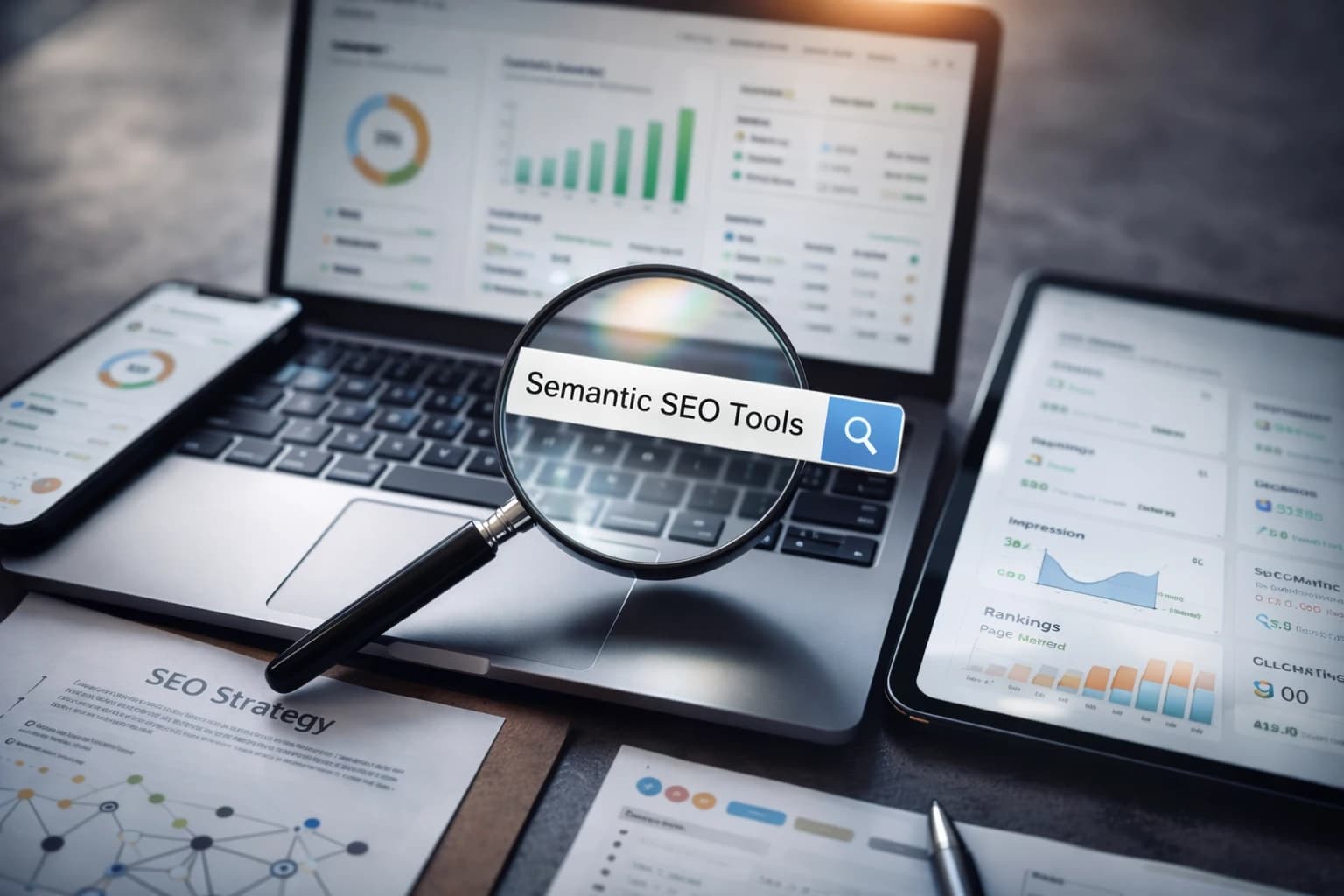
A content strategist stares at a whiteboard crowded with entities, questions, and rival page titles. One sticky note says “Python.” Another says “API.” A third says “tutorial for beginners.” She is not trying to find one more keyword. She is trying to use semantic seo tools to turn a broad topic into a map that can win both classic rankings and AI answers.
If you have done this work for real, you know the pain point. A plain keyword list does not tell you whether a page covers the right concepts, answers the right questions, or signals the right context to Google, ChatGPT, Gemini, or Perplexity. It just hands you fragments.
That is why semantic SEO matters now. Search engines do not read pages like filing cabinets. They interpret relationships. AI answer systems do the same thing, often even more aggressively, because they synthesize across multiple sources instead of matching one phrase to one page.
There is also a scope problem in the market. Some vendors treat semantic SEO as keyword discovery. Others extend it into clustering, content editing, workflow, reporting, and AI visibility. You need to see that difference early, or you will buy a shiny research tool and still miss your publishing deadlines.
Semantic SEO Tools Fundamentals: What They Are and Why They Matter
Semantic keywords vs. exact-match keywords
Semantic SEO tools are meaning-based research and optimization systems. They help you identify the words, entities, questions, and concepts that define a topic, not just the phrase you hope to rank for. One semantic keyword research tool describes semantic keywords as words with similar meaning or related to the same context. That is the heart of the discipline.
Exact-match keywords still have a place. If you sell “project management software,” you should know whether people search that phrase. But the page that wins usually covers adjacent needs too: onboarding, integrations, templates, reporting, pricing, migration, permissions, and use cases for teams like agencies or SaaS companies. Meaning widens the frame.
| Approach | What You Optimize For | Example | Main Weakness |
|---|---|---|---|
| Exact-match | One phrase and close variants | “python tutorial” | Can miss intent shifts like setup, libraries, debugging, or use case |
| Semantic | Meaning, entities, questions, context | Python plus API, database, package manager, Jupyter | Needs stronger planning, page structure, and editorial discipline |
Entities, context, and topical authority
Entities are the named things inside a topic: brands, people, products, technologies, places, standards, and concepts. Context tells search systems which meaning you intend. A widely cited example is “Python.” If the surrounding terms include “database” or “API,” Google can infer you mean the programming language. If the page mentions “cobra” or “habitat,” the meaning shifts.
That same semantic keyword research source argues that semantically related keywords help Google disambiguate entities with the same spelling. It also says that related terms can signal page quality and how fully a page covers a topic. That is why topical authority is not magic. It is accumulated context across a cluster of pages.
Semantic SEO is about meaning and coverage, not keyword stuffing.
Where semantic SEO fits in modern content workflows
In practice, semantic SEO lives between raw research and published assets. You start with a core topic, build a semantic map, group subtopics by intent, assign pages, create briefs, write or update content, add internal links, tighten schema, and then monitor how the cluster performs. If your team skips any step, the map stays theoretical.
This is where tool categories start to blur. One platform may focus on semantic maps and related questions. Another may add a Content Editor, an AI Writer, or AI search tracking. Neither model is wrong. They solve different parts of the workflow. Your job is to know where research ends and execution begins inside your own stack.
How Semantic SEO Tools Work Behind the Scenes
Generating semantic topic maps
Behind every “topic map” button sits a simple idea: start with a seed topic, then pull the nearby concepts search systems associate with it. One semantic keyword research tool says it can generate semantic maps and identify popular queries, questions, and entities related to a topic. That matters because search demand rarely arrives as one clean phrase.
Say your seed topic is “customer data platform.” A decent system should surface related queries such as setup, use cases, comparisons, implementation questions, and neighboring entities like analytics, identity resolution, CRM, consent, and integrations. If the output stops at synonyms, it is too shallow for planning.
Finding questions, entities, and related concepts
The next layer is where good research becomes useful. The same tool also claims it finds what queries, entities, questions, and concepts Google thinks are closely related to a topic. That phrasing is useful because it shifts the goal. You are not brainstorming from scratch. You are mapping the topical neighborhood Google already recognizes.
For a page about “email deliverability,” for example, you would want questions like “why emails go to spam,” entities like SPF, DKIM, and DMARC, and concepts like sender reputation, authentication, and bounce rate. Those details shape the outline, the subheads, the supporting pages, and even the anchor text you use in internal links.
Clustering topics into workable content plans
Research becomes operational when you cluster it. SE Ranking includes tools such as Keyword Grouper and Content Editor in its content workflow, which is a good signal of how these systems are meant to be used: not as isolated reports, but as bridges from discovery to production.
- Choose a core topic with clear business value.
- Collect related queries, questions, entities, and concepts.
- Group them by search intent and page type.
- Decide what belongs on a pillar page and what deserves a support article.
- Turn each cluster into a brief with required coverage points.
- Publish, interlink, and measure the cluster as a system.
That is how you stop writing 12 overlapping posts on “CRM software” and start building one coherent cluster instead. Every mature content team I have seen eventually learns this lesson the expensive way.
If a tool does not surface entities, questions, and clusters, it is only solving part of the problem.
Best Practices for Using Semantic SEO Tools Well
Start with a visibility audit, then build the content plan

Do not begin with a blank page if you already have 400 URLs live. Begin with a visibility audit. Look at what ranks, what nearly ranks, what gets impressions without clicks, what pages overlap, and where your entity coverage is thin. Semactic says ActivSEO connects a visibility audit directly to a collaborative action plan with AI-powered recommendations. That framing is smart because it forces action after diagnosis.
Here is a common example. A B2B SaaS site may have solid rankings for “email marketing platform” but weak coverage around deliverability, segmentation, automation workflows, and compliance. The audit tells you whether to create new cluster pages, merge duplicates, or strengthen an existing pillar before you produce anything new.
Use AI and classic search tracking together
Classic rankings still matter. They pay bills. But answer engines now sit on top of discovery in ways that old dashboards miss. SE Ranking’s AI Search Toolkit includes trackers for AI Overviews, AI Mode, ChatGPT, Gemini, and Perplexity. Whether you use that platform or another, the principle is the same: you need both blue-link data and answer-layer visibility.
A page can rank number three in Google and still miss AI citations because it lacks direct definitions, clean entity coverage, or concise comparison language. The reverse can happen too. A brand may show up in Perplexity answers before it dominates classic rankings, especially on comparison or explainer queries.
Optimize for the answer layer, not just the blue-link ranking.
Connect research outputs to editorial and optimization tasks
The strongest teams do not stop at exports. They turn cluster outputs into work tickets, briefs, and publishing checklists. This is why platforms aimed at agencies, enterprises, and growing businesses increasingly mix research with workflow. The data is only useful when someone can ship against it this week.
- Assign an owner for each topic cluster.
- Define the page type: pillar, comparison, glossary, feature page, or support article.
- List the must-cover entities, questions, and related concepts.
- Map internal links across the cluster before drafting.
- Add schema needs, on-page checks, and publish dates.
- Review both ranking movement and AI visibility after launch.
If you skip that handoff, semantic research becomes the SEO equivalent of a beautiful whiteboard photo nobody opens again.
Common Mistakes Teams Make With Semantic SEO Tools
Buying tools without an execution process
This is the most common failure I see. A team buys a platform, runs a few reports, exports CSV files, then goes back to business as usual. No editorial slots change. No page templates change. No internal linking rules change. Six months later, the subscription becomes shelfware.
Semactic puts it bluntly: a diagnosis without execution is just noise. The company also says its platform does not explain SEO basics; it gives experts structure, data, and workflow. That distinction matters. Advanced teams rarely fail because they lack another audit. They fail because nobody owns the follow-through.
Over-focusing on generic keyword lists
Semantic SEO is not a synonym contest. A giant list of “related keywords” feels productive, but it can drag you into thin, repetitive content if you do not group by intent and context. The goal is to help search engines understand what the page is actually about, not to sprinkle adjacent phrases like seasoning.
Take “CRM software.” A weak workflow chases every variant: best CRM, CRM tools, CRM platform, top CRM system. A stronger workflow asks what users and search systems need to see around the topic: migration, sales pipeline, integrations, pricing model, onboarding, reporting, and security. That is coverage. That is context.
A tool is not a strategy.
Ignoring AI visibility and cross-channel search behavior
Search behavior no longer stays inside one results page. A buyer may start in Google, scan an AI Overview, open ChatGPT for comparisons, and then come back to branded search later. If your reporting only tracks classic positions, you can miss mentions, citations, and recommendation patterns that influence the click before the click.
This does not mean you abandon traditional SEO. It means you widen the lens. Some vendors now talk about an SEO visibility command center and a separate AI visibility command center. Others combine both. Either way, you need a view of how your brand appears across Google, ChatGPT, Gemini, and Perplexity if you care about real discovery.
Semantic SEO Tool Categories and What to Look For
Research and semantic discovery tools

These tools help you understand the shape of a topic. You want semantic maps, related queries, entity extraction, question discovery, and concept relationships. Their job is to answer, “What must this cluster cover if we want the page set to feel complete?”
They are great for market expansion, editorial planning, and gap analysis. They are not enough on their own if your team also needs on-page optimization, publishing workflow, or reporting. Buy them when discovery is your bottleneck, not because the interface looks clever.
Optimization and content workflow tools
This category takes research and turns it into production. SE Ranking lists tools such as Rank Tracker, Keyword Research, On-Page SEO Checker, Website Audit, Competitor Analysis Tool, and Backlink Checker. It also offers a Content Marketing Tool, Content Editor, AI Writer, SEO Dashboard, and Report Generator. That stack reflects a wider trend: teams want research, writing, optimization, and reporting closer together.
When you evaluate this category, look for practical bridges: brief generation, required topic coverage, internal linking prompts, review workflows, schema guidance, and issue tracking. If your writers still have to rebuild the brief in three other systems, your “platform” is really just a report source.
Monitoring, reporting, and AI visibility tools
Once content ships, the question changes. Now you need to know what moved, what slipped, and which surfaces mention you. SE Ranking combines classic SEO tools with AI search tracking tools, while Semactic positions ActivSEO as an SEO visibility command center and ActivGEO as an AI visibility command center. That is a useful difference to understand: some vendors bundle classic and AI tracking, others split them.
For most teams, the right choice depends on operating style. Agencies may want cleaner client reporting. In-house teams may prefer one workspace. Publishers may prioritize cluster-scale monitoring. SaaS brands may care most about comparison queries and AI mentions. Buy for your workload, not for the longest features page.
Buy for the job you need done, not for the biggest feature list.
| Category | Primary Job | Must-Have Outputs | Best Fit |
|---|---|---|---|
| Research and discovery | Map the topic space | Queries, questions, entities, concepts, clusters | Teams building new clusters or auditing coverage gaps |
| Optimization and workflow | Turn research into publishable assets | Briefs, content guidance, on-page checks, internal link tasks, schema prompts | Editorial teams, agencies, growth squads |
| Monitoring and reporting | Track performance across search surfaces | Rank tracking, AI visibility, dashboards, reports, change alerts | Brands and publishers managing ongoing performance |
If you are comparing options this quarter, ask six plain questions:
- Does it surface entities, questions, and concepts, or only keywords?
- Can it cluster topics into page-level plans?
- Does it connect research to briefs and optimization tasks?
- Can it track both classic rankings and AI answer visibility?
- Will your team actually use it inside the current workflow?
- Can it show what changed after publication, not just what exists now?
Conclusion: Build a Semantic SEO Stack That Turns Research Into Rankings and Mentions
From topic map to published asset
Choose systems that turn related queries, questions, entities, and concepts into briefs your team can actually ship.
From ranking checks to AI visibility checks
Classic rank tracking still matters, but paired AI monitoring shows whether Google, ChatGPT, Gemini, or Perplexity surface your brand.
From one-off tasks to repeatable workflows
The best stacks move from visibility insight to action on a schedule, not in scattered bursts.
Semantic SEO tools pay off when they connect discovery, execution, and measurement without slowing your team down.
As search keeps shifting toward blended answers, which part of your semantic seo tools workflow will you tighten first—research, publishing, or AI visibility tracking?
Scale Semantic Wins With SEOPro AI
SEOPro AI gives teams LLM SEO tools for ChatGPT, Gemini, and other AI agents—automating creation, publishing, clustering, schema, internal linking, and performance monitoring at scale.
Grow Traffic